6 Month Supply
6 bottles delivered every 180 days

FREE SHIPPING
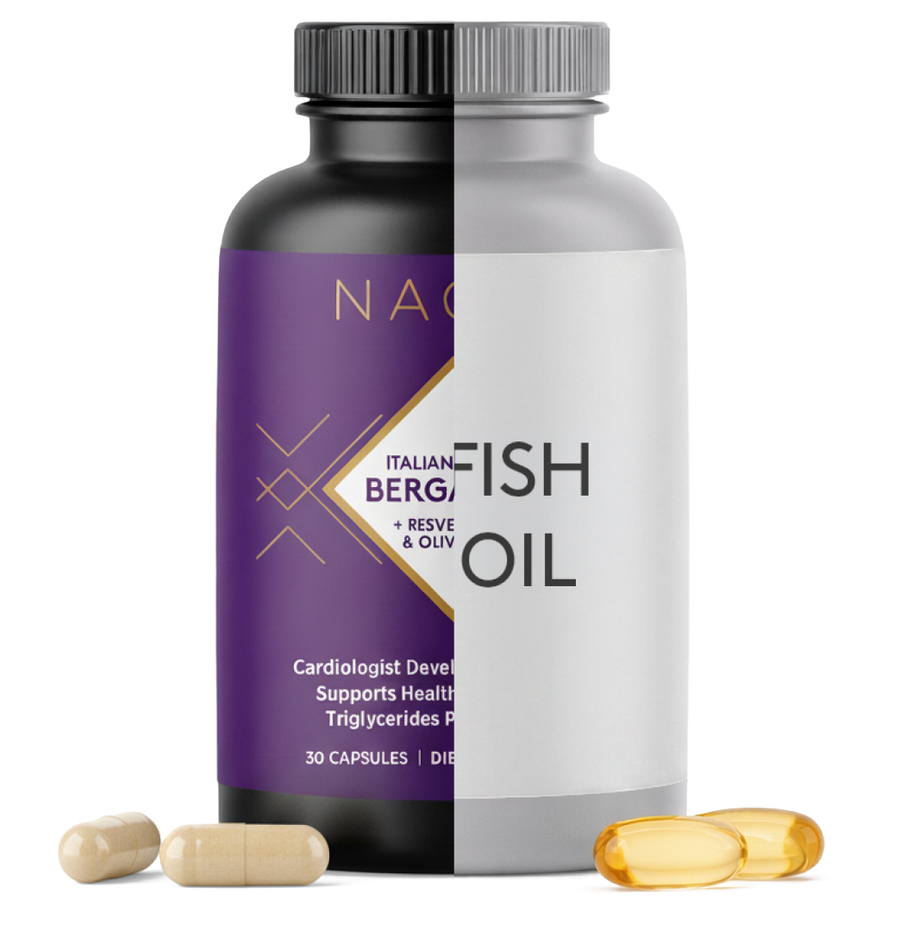
Fish oil barely moves the needle — and does nothing for your cholesterol ratio or HDL. Citrus bergamot tackles all three, faster.
Fish oil has long been recommended for triglycerides — but the evidence tells a different story. While fish oil may offer a modest 13% reduction in triglycerides after 16 weeks of use, it produces no significant change in total cholesterol ratio or HDL levels.
Citrus Bergamot 500 MG, by contrast, delivers a comprehensive lipid panel improvement backed by clinical research: a 21% reduction in total cholesterol ratio, a 22% increase in HDL, a 29% drop in triglycerides, and an 18% reduction in post-meal blood sugar — all in as little as 30 days.
If you're taking fish oil hoping to protect your heart health, bergamot does everything fish oil does — and everything it doesn't.
Naomi Bergamot
Impacts TG/HDL Ratio in 30 days
Fish Oil
Modest impacts TG/HDL over 16 weeks.
For decades, fish oil has been the go-to supplement for people worried about their triglycerides. Doctors mentioned it. Pharmacies stocked it. Wellness blogs repeated the advice so often it became gospel: take your omega-3s.
But here's what most people don't know: the research on fish oil is a lot murkier than the marketing suggests. Studies show that while fish oil can reduce triglycerides by around 13%, it doesn't meaningfully improve your total cholesterol ratio — the number that matters most for cardiovascular risk. It doesn't raise HDL, the "good" cholesterol that helps clear plaque from your arteries. And it takes 16 weeks — four full months — to even get to that modest result.
Meanwhile, millions of people are dutifully swallowing fish oil capsules every morning, assuming they've done something meaningful for their heart. Most haven't.
Bergamot is a citrus fruit grown primarily in the Calabria region of southern Italy — you may recognize the name from Earl Grey tea, which gets its distinctive flavor from bergamot oil. But beyond tea, the fruit's polyphenol-rich extract has been the subject of serious cardiovascular research over the past decade.
The results have been striking. Bergamot polyphenols appear to work on multiple pathways simultaneously — inhibiting cholesterol synthesis in the liver (similar in mechanism to statins, but naturally derived), improving insulin sensitivity, and reducing oxidative stress in blood vessel walls. The result is a broad-spectrum lipid panel improvement that fish oil simply cannot match.
In clinical studies, participants taking 500 mg of citrus bergamot daily saw:
When your doctor checks your cholesterol, the single most predictive number for cardiovascular risk isn't your LDL in isolation — it's your total cholesterol to HDL ratio. A high ratio means more harmful cholesterol relative to the protective kind. Fish oil does nothing to move this number. Bergamot drops it by 21%.
HDL cholesterol — the "good" kind — acts as a scavenger, pulling LDL and plaque out of your arteries and back to the liver for processing. Higher HDL is one of the strongest protective factors against heart related conditions. Fish oil leaves HDL unchanged. Bergamot raises it by 22%.
Triglycerides — the fat particles circulating in your blood after meals — are a genuine risk factor, especially when elevated alongside low HDL. Fish oil reduces them by 13% after 16 weeks. Bergamot reduces them by 29% in 30 days.
The pattern is consistent: across every meaningful cardiovascular marker, bergamot outperforms fish oil — often dramatically, and always faster.
Most people leave their doctor's appointment focused on one number: LDL. "Bad cholesterol" has dominated the heart health conversation for decades, and for good reason — elevated LDL is a genuine risk factor for cardiovascular events. But an increasingly large body of research suggests that LDL alone is an incomplete picture, and that triglycerides — the fat particles that circulate in your blood after you eat — may be just as important, if not more so.
Triglycerides are produced when your body converts excess calories, especially from refined carbohydrates and sugar, into fat for storage. After a meal, your triglyceride levels spike as this conversion process kicks in. Over time, it can impact blood flow and sets the stage for cardiovascular challenges.
A large meta-analysis of 32 cohort studies found that triglycerides are an independent risk factor for coronary issues., alongside total cholesterol, LDL, and HDL — each contributing its own separate layer of risk.[1]
But here's what makes triglycerides particularly dangerous: they rarely travel alone. High triglycerides almost always accompany low HDL — and it's the combination of these two factors that paints the most alarming picture of cardiovascular risk.
The triglyceride-to-HDL ratio (TG/HDL) is one of the most powerful and underutilized tools in cardiovascular risk assessment. While your doctor may focus on LDL, research consistently shows that TG/HDL is a stronger and more comprehensive predictor of heart related issues.
The logic is straightforward: triglycerides are atherogenic — they promote plaque formation. HDL is protective. When triglycerides are high and HDL is low, you get the worst of both worlds decreased blood flow and arterial function. The ratio captures this dynamic in a single number that LDL cannot.
In one landmark study by Gaziano and colleagues, a high TG/HDL ratio was associated with a 16-fold increase in the risk of myocardial infarction in patients with no prior history of coronary artery disease.[2] A separate study published in the European Heart Journal found that patients with higher TG/HDL ratios had significantly more high-risk coronary plaques on CT angiography, and faced nearly double the rate of future coronary events over a four-year follow-up period.[3]
Research published in Scientific Reports found that the highest quartile of TG/HDL ratio was associated with nearly three times the risk of all-cause mortality and non-fatal heart attack in patients with stable angina — while total cholesterol and LDL showed no statistically significant relationship with outcomes in the same group.[4] In other words, LDL was a bystander. TG/HDL was the predictor.
Your TG/HDL ratio is calculated simply: divide your triglyceride level by your HDL level. Both numbers appear on a standard lipid panel. A ratio below 2.0 is generally considered ideal. Between 2.0 and 4.0 indicates moderate risk. Above 4.0 is considered high risk and warrants serious attention.[7]
The challenge for most people is that both numbers are moving in the wrong direction simultaneously — triglycerides creeping up as diets worsen and activity drops, HDL falling as the same lifestyle factors suppress it. Fish oil addresses only one side of this equation, and modestly. Citrus bergamot addresses both — cutting triglycerides by 29% while simultaneously raising HDL by 22% — delivering a compounded improvement to the ratio that fish oil simply cannot replicate.
One area where the comparison becomes particularly striking is post-meal blood sugar. After you eat, your blood glucose spikes before insulin brings it back down. Repeated large spikes over time contribute to insulin resistance, metabolic syndrome, and imbalanced glucose levels — conditions that are also closely linked to serious cardiovascular conditions.

Naomi Bergamot
Post-Meal
Blood Sugar

Fish Oil
Post-Meal
Blood Sugar
Citrus bergamot reduces post-meal blood sugar by 18%. Fish oil? This has never even been studied in this context. It's not a gap in fish oil's performance — it's a gap in fish oil's ambition. Bergamot addresses a risk factor that fish oil isn't even designed to touch.
If you're currently taking fish oil for cardiovascular support, the transition to citrus bergamot is simple. One 500 mg capsule daily is the studied dose. No fishy aftertaste. No refrigeration. And results you can measure at your next lipid panel — typically within 30 days.
This isn't about dismissing fish oil entirely. Omega-3 fatty acids have other benefits — anti-inflammatory effects, brain health support — that remain worth discussing with your doctor. But if your goal is to improve your triglycerides, raise your HDL, and lower your cardiovascular risk, fish oil is the wrong tool for the job.
Citrus bergamot does more. It does it better. And it does it faster.
6 bottles delivered every 180 days

FREE SHIPPING
3 bottles delivered every 90 days

FREE SHIPPING
1 bottle delivered every 30 days

FREE SHIPPING
The Only Award Winning Citrus Bergamot
NAOMI Citrus Bergamot features Bergamore®, the patented form of citrus bergamot that clinical research shows produces dramatic support for cardiovascular health including support for normal LDL and HDL cholesterol, triglyceride levels and blood sugar levels.
This formula is also enhanced with a proprietary Resveratrol Blend for free-radical fighting antioxidant support as well as Olive Leaf Extract additional cardiovascular support.*
As with many nutritional supplements, it can take a little time to build up in your system to start producing results. The clinical research demonstrates significant support for cardiovascular health after taking citrus bergamot daily for 30 days.*
Yes. While the standard daily dose of Citrus Bergamot is 500 mg of Bergamore®, the clinical research shows that for people who might need extra help with cholesterol and other cardiovascular issues, a 1000 mg daily dose is both safe and effective.
Yes. While our products are gluten-free, they are manufactured in a facility that is not gluten-free. This is important information for those with celiac disease - not for the general population looking to cut out gluten for general wellness and weight management purposes.*
Our citrus bergamot formula features Bergamore® citrus extract which has been scientifically shown to support healthy levels of “bad” LDL cholesterol while helping increase “good” HDL cholesterol, reduce total cholesterol ratio, reduce triglycerides and reduce post-meal blood sugar levels. It also features antioxidant-rich extracts of olive leaf and a proprietary resveratrol blend to support overall cardiovascular health.*
Yes, in the clinical study of Citrus Bergamot, over the course of 30 days, results showed:

Dr. Suzanne Steinbaum is a leading preventive cardiologist in New York City, CEO and Founder of Heart-Tech Health, and NAOMI's Trusted Medical Advisor. A national spokesperson for the American Heart Association's Go Red campaign for nearly two decades, she has launched heart disease prevention programs at three top NYC academic hospitals and authored Dr. Suzanne Steinbaum's Heart Book. Dr. Steinbaum brings her clinical expertise to NAOMI's formulations — ensuring every product meets the evidence-based standards she sets for her own patients.
Naomi Whittel was born in Switzerland, educated in the U.S., and for over 20 years has been exploring the world to uncover the most potent and effective natural health solutions on earth. Named by Prevention magazine as a leading innovator in the natural products industry, she is a fierce advocate for empowering women to take control of their health and the health of their families. Naomi is the founder of Reserveage Nutrition, has served as CEO of TwinLab, and is the author of Glow15, the New York Times best-selling book on diet and healthy lifestyles, as well as High Fiber Keto. An avid fitness enthusiast, Naomi is the mother of four children and lives in Florida.